January 29th 2026
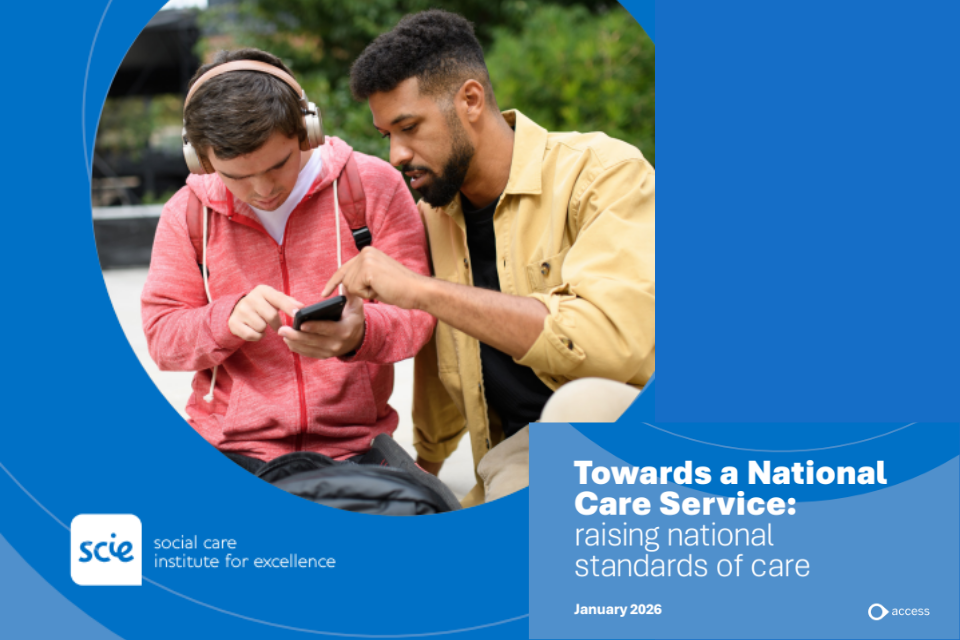
The Social Care Institute for Excellence (SCIE) has published a new report, Towards a National Care Service: raising national standards of care, exploring how national standards could support more consistent, fair and high-quality adult social care across England.
The report is based on a series of national policy roundtables involving people who draw on care, unpaid carers, providers, commissioners, policymakers and researchers. It is intended to inform the work of the Casey Commission and wider government thinking on the future of adult social care.
A central message running throughout the report is that national standards will only deliver meaningful change if they are underpinned by strong data and digital foundations.
Digital Care Hub response
Michelle Corrigan, Programme Director at Digital Care Hub, said:
“Digital Care Hub welcomes SCIE’s report, which reflects our position that a future National Care Service has to be built on the intelligent use of good quality data. Data and digital technology are not add-ons to reform. They are central to understanding what good care looks like, improving outcomes for people who draw on care, and tackling the inequalities that persist across the system. Used well, data can support learning, transparency and better decision-making at every level of social care.”
What SCIE says a future National Care Service could be
SCIE does not present a National Care Service as a single organisational model. Instead, the report focuses on the role of national standards in clarifying what people should be able to expect from care and support, wherever they live.
The report emphasises that standards should:
- Focus on outcomes and lived experience, not tasks or services
- Reduce unjustified variation in access and quality
- Support greater consistency and accountability across a fragmented system
SCIE is clear that national standards alone cannot solve deep-rooted challenges such as workforce shortages or underfunding. However, when designed well, they can help translate existing legal duties and values into more consistent day-to-day practice.
Why data and digital foundations matter
A key finding from the roundtables is that adult social care currently collects large volumes of data, but much of it focuses on activity and compliance rather than on what matters most to people’s lives.
SCIE highlights that existing data is often:
- Fragmented across organisations and systems
- Retrospective and slow to use
- Poorly aligned with lived experience and outcomes
The report warns that without better data and digital capability, national standards risk becoming either aspirational statements or narrow compliance tools. Instead, data should support learning, improvement and transparency.
A data and digital “spine” for national standards
Within this context, SCIE introduces the idea of a data and digital “spine” to support a future National Care Service.
Rather than a single system, this spine is described as a way of creating more coherent system intelligence, aligned to national standards. SCIE suggests this would involve:
- Outcomes and evidence metrics that reflect what matters to people’s lives, developed through co-production
- Greater use of qualitative evidence alongside quantitative data, including lived experience, feedback and peer learning
- Better use of existing datasets, alongside improvements in timeliness, relevance and integration over time
The report argues that without this kind of spine, it will be difficult to demonstrate whether standards are improving care or to shift behaviour away from narrow activity measures.
Interoperability, trust and inclusion
SCIE also highlights how fragmented digital systems contribute to poor experiences at key points such as hospital discharge, transitions between services and safeguarding situations. The report stresses the importance of interoperable data arrangements, with clear expectations about information sharing.
Alongside this, SCIE raises ethical considerations around consent, transparency and digital inclusion. People must be able to access and understand their own records, and trust that data use supports better care rather than surveillance or exclusion.
Why this matters now
As debate continues about the future of adult social care, SCIE’s report reinforces that data and digital infrastructure are not secondary concerns. They are central to whether national standards support improvement, learning and equity, or default to compliance.
Digital Care Hub will continue to support adult social care providers, commissioners and system leaders to strengthen data capability, digital confidence and responsible use of technology, in line with the principles set out in the SCIE report.
View all News