July 17th 2026
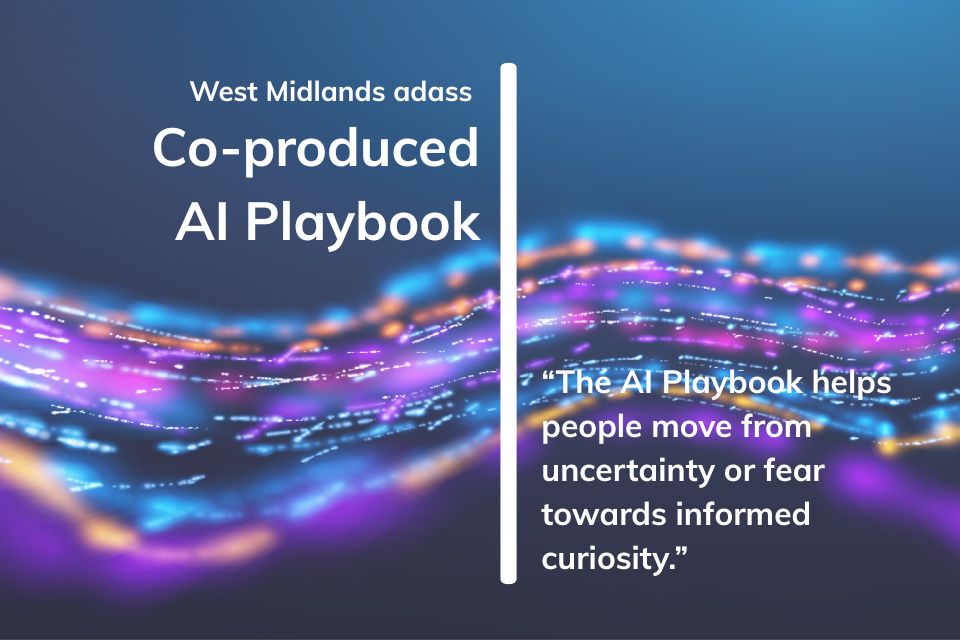
Artificial intelligence is already shaping everyday life, including adult social care. In response to this, the West Midlands ADASS (alongside other partners – credited below) has co-produced an AI Playbook resource. The playbook has been collaboratively created, with the resource and content defined and led by people with lived experience, unpaid carers, professionals, digital leads and care organisations to support choice, control, confidence and safer digital decision-making.
Access the AI playbook, here.
The challenge
From predictive text and voice assistants to apps that help people manage appointments, information and communication, AI is already appearing in tools people use every day,
Alongside this, the rate and depth of adoption of AI tools and support is varied. Some people are using AI without realising it, while others are worried or nervous about privacy, fairness, access and impact on human relationships.
The AI playbook project was instigated to respond to where people are currently at with AI, to support them with the knowledge to harness tools already available, reduce barriers to usage and benefit, and as a place for guidance and inspiration in the usage of AI in the social care sector.
Putting co-production at the centre
Co-production shaped the Playbook from the beginning. The project started with a blank sheet and grew through workshops, conversations and advisory group discussions with people with who draw on care, unpaid carers, council officers, local authorities, voluntary sector organisations and other partners.
People who are in receipt of care and receive support from different services were recognised as experts in what they need, including understanding the best way that AI can support their needs. Their stories helped define the priorities, language and tone of the resource, including where people needed reassurance and how guidance could avoid being overwhelming or inaccessible.
Groups and Individuals involved:
WM-ADASS C-production Advisory Network
WM-ADASS-Co-production Leads Group Network
Our Way in Worcestershire
Beacon Vision in Dudley
Personal contributors
What the Playbook includes
- Plain language AI guidance that is accessible
- Responsible use principles for AI
- Case studies from individuals showing current use of AI.
- Example 1: A story/example from Graham: Graham’s story | WMADASS
- Example 2: Illustrating tools that help people communicate or organise information.
- Examples of how AI is being used in care environments
- Eg. Virtual reality in a care home to support calm environments
- Coaches that can respond to individual need.
- West Midlands ADASS AI Coaches are based on the WM ADASS team and their experiences.

The West Midlands adass AI Playbook coaches are a key part of the AI Playbook, and help personalise the experience for users
Digital impact
The Playbook helps people move from uncertainty or fear towards informed curiosity, while making clear that AI must be used with care, transparency and human oversight. It supports people to explore tools that could aid independence and helps professionals and commissioners ask whether AI is inclusive, ethical and useful before it is adopted.
More confidence: people felt more able to understand and use AI after seeing practical examples and safeguards.
Greater independence: examples showed how AI can support communication, information access and daily organisation.
Stronger accountability: the Playbook reinforces that AI should support human decision-making, not replace judgement, safeguarding or relationships.
Perceptions of AI during the project
Through the project, people moved from resistance or uncertainty to feeling more able to understand and use AI. People with lived experience were not only consulted; they shaped the content and helped others see where AI could support real outcomes.
The project showed that AI has value when it helps people have more choice and control, and when it gives care workers more time to build relationships rather than replacing those relationships.
What others can learn
- Start with people, not products: begin with what matters to people drawing on care and support.
- Make accessibility essential: accessible language, formats and design choices should be built in from the start.
- Be honest about risk: guidance should acknowledge bias, exclusion, privacy, consent and the limits of AI outputs.
- Keep humans in control: AI should support decision-making and reduce burden, but safeguarding, accountability and compassion must remain with people.
Why it matters for digital care
The AI Playbook shows how co-production can turn a complex digital topic into something practical, inclusive and useful. By involving people with lived experience from the outset, the project created guidance that speaks to real hopes and concerns, not just technical possibilities.
For the wider sector, the learning is clear: AI should not be imposed on people or used as a shortcut for care. Used well, it can support independence, improve access to information and reduce pressure on staff, but digital change must be shaped by the people it affects most.
What’s next?
Adass and the partners who co-produced the resource are hopeful that it will help and support many others with their individual usage.
The AI playbook also illustrates the power of co-production processes and the importance of placing need and people at the forefront of tech development.
Digital Care Hub would like to thanks West Midlands adass for their openness and support in sharing their learning in connection to this project, and in compiling this case study.
View all case studies