June 22nd 2026
Oakland Care Group is a family-owned care provider with over 30 years’ experience. The organisation has a strong ethical focus, prioritising investment in residents, team members, and person-centred care. Kevin Humphrys, Chief Executive Officer, shares their approach to selecting, implementing and evaluating technology.
“Thirty years of reputation rests on one thing: families trusting us with the people they love. Every digital tool we adopt has to strengthen that trust, not complicate it.”
Kevin Humphrys, Chief Executive Officer, Oakland Care Group.
The intention
Oakland Care Group wanted to adopt digital tools to help with efficiency and digital safety and were very specific about how they wanted technology to impact and improve their service.
Key challenges they were keen to solve or avoid included:
- Time-intensive processes (e.g. care planning taking up to 4 hours)
- Ensuring new technology genuinely improved care delivery
- Avoiding fragmented or poorly integrated systems
- Maintaining data security and staff confidence in digital tools
- Managing increasing cyber security risks across systems and staff behaviours
‘Pain point first’ philosophy
Rather than adopting technology reactively, Oakland Care Group developed a priority system they call the “pain point first” philosophy:
- Identify inefficiencies or gaps in care delivery
- Define what “better” looks like
- Only then selecting or designing technology to meet that need
Every digital investment is:
- Purpose-driven
- Measurable
- Aligned with care outcomes
AI-assisted care planning for integration and safety
The company wanted to transform reactive care into preventative health management – identifying patterns that might indicate a urinary tract infection, deteriorating mobility, or other clinical risks before they escalate into hospital admissions.
Approach
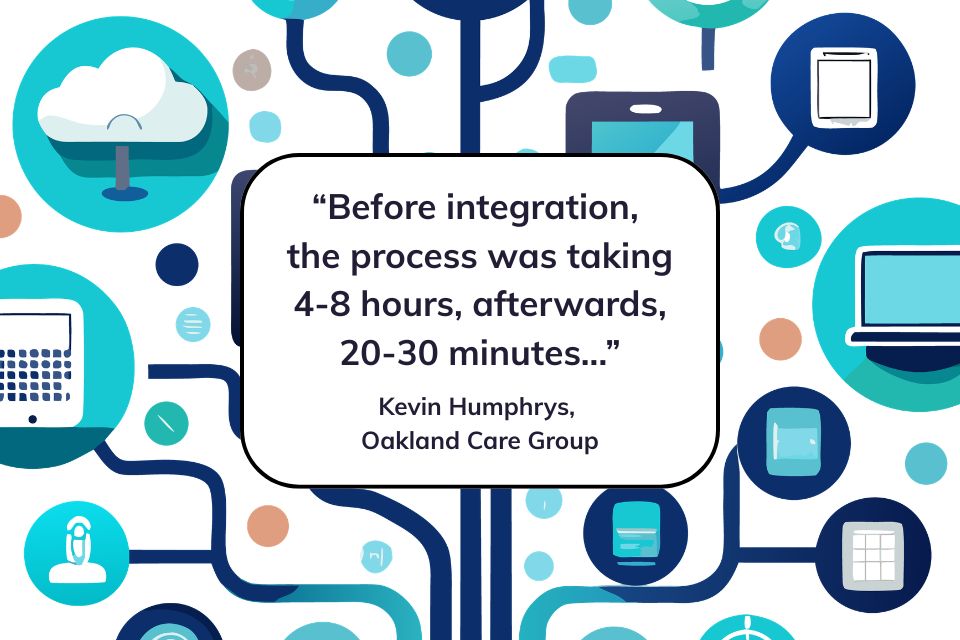
Oakland Care Group introduced an AI-supported workflow using CareSpace, a GDPR-compliant platform, to reduce care planning time. The outcome of introducing AI assistance resulted in a significant reduction in the time taken to create a care plan. Before AI-integration, the process was taking 4-8 hours, afterwards, this reduced to 20-30 minutes.
The practical actions
- AI was programmed to ask clarifying questions – the system did not guess or fill gaps unnecessarily.
- An open and honest approach to AI
“We insisted on Glass Box AI – transparent audit trails showing what went in, what prompts were used, what came out. If you can’t trace a decision, you shouldn’t trust it.”
- Outputs were formatted for direct use in care systems
- Processing was GDPR-compliant with data redaction and secure environments
- A two-person verification process was in place before sign-off
The result
The approach and actions of this project ensured efficiency without compromising safety or accuracy and resulted in predictive clinical intelligence. There are numerous AI-powered systems which Oakland Care group have adopted, and which are working well for the organisation.
Oakland Care Group developed PredictaAI, a proactive clinical intelligence system designed specifically for the care home environment. The system analyses four-week cycles of resident data to identify the subtle behavioural and physiological “digital biomarkers” that often precede serious health events.
The organisation uses Feebris, an AI-guided tool that helps care practitioners capture vital signs using peripherals such as thermometers, blood pressure cuffs, and SpO₂ monitors. The system provides guidance on when to escalate care, enabling more effective support for residents without replacing professional clinical judgement.
Oakland Care Group uses Maxxo AI to support enquiry handling. The system listens to incoming calls, transcribes them, enters details into Coolcare, and books visits through calendar access. This operates around the clock, ensuring no enquiries are missed over weekends or outside office hours.
AI governance framework: Seven principles
- Truth – Technology grounded in accurate, reliable data. AI outputs only from information reflecting the realities of the people in their care.
- Transparency – Clear about how AI functions and the decisions it supports. A register of approved tools. Documentation of AI contribution to care plans.
- Equity – AI must not reinforce existing inequalities. Regular audits for bias. Team members trained on unconscious bias when reviewing outputs.
- Trust – Respect privacy, uphold human rights, serve the interests of residents. Technology supports professional judgement but never replaces it.
- Accessibility – Designed so everyone can use and benefit, regardless of age, digital literacy, or ability. Easy Read versions, large print, verbal explanations, translated materials where needed.
- Humanity – AI enhances, never replaces, the human touch. A regular check: is technology bringing us closer to residents or further away
- Responsiveness – Regular evaluation and updates. Listening to team members, residents, and families. Fixing issues quickly and transparently.
These principles are in alignment with the ethical principles for the use of AI in social care contexts, as developed by the Oxford AI Project. Read more: Ethical principles for the use of AI in social care contexts – Digital Care Hub
Proactive falls prevention technology
The organisation implemented Nobi, an AI-powered ceiling-mounted smart lamp system in residents’ bedrooms.
Nobi provides fall detection that distinguishes genuine falls from normal movements and offers immediate room illumination and verbal communication with the resident through the lamp. It also sends alerts to team members via handheld devices and phones and tracks activity and patterns over time – highlighting nocturnal activity and mobility changes.
This data then feeds into care planning. For example; increased nocturnal restlessness might indicate a need for medication review or UTI assessment or consistent 3am rising might benefit from a scheduled 2:45am comfort check.
Impact:
- Response times reduced to ~2 minutes after a fall
- Improved early intervention when residents are at risk
- Enhanced resident safety and reassurance
- Nothing for residents to wear, remember, or charge – particularly valuable for those with cognitive impairment
- Families notice the difference. As one daughter shared: “The staff are extremely responsive both to the residents and also family members. It’s a great comfort to know that she is well cared for.”
Cyber security – building a culture, not just a system
Oakland Care Group treats cyber security as a shared responsibility across the organisation and has associated key measures:
- Technical protection: Security Operations Centre (SOC) monitoring, Firewall management with external IT support, Email security tools (e.g. phishing protection), Regular penetration testing and vulnerability scanning
- Real-world staff training (SATT): Security Awareness Training and Testing protocols for all staff, Simulated phishing attacks sent to staff, Instant retraining triggered if risks are identified, Ongoing testing to maintain awareness
- Data protection by design: Secure environments for AI processing, Data redaction before external processing; Strict controls on data access and export, Only two approved AI platforms (CareSpace for anything involving resident data, and Microsoft 365 Copilot for high-level reporting, emails, and non-resident information).
- The result is a proactive, continuously improving cyber resilience model.
Integrated digital ecosystem
Recognising the opportunity an integrated digital ecosystem could have, Oakland Care Group focused on integration across systems.
Each system was integrated with existing platforms, works on mobile and handheld device, and was chosen to reduce (not increase) administrative burden.
These systems are:
- Nourish – care planning and recording
- Coolcare – rostering, payroll, resident invoicing, maintenance
- CareSpace – AI-assisted care plan and risk assessment composition (GDPR-compliant)
- CareSpace CHM – co-developed management tool for incidents, safeguarding, CQC notifications, clinical risks, MCA/DoLS tracking
- Nobi – AI-powered falls prevention
- Ayla – digital Cognitive Stimulation Therapy delivery
- Citation Atlas – H&S, compliance, training, ISO 9001:2015 QMS
- PredictaAI – our own proactive clinical intelligence system
- Feebris – AI-guided vital signs capture
- Maxxo AI – 24/7 enquiry handling
Next steps and ongoing work
“We continue to work towards integration, to the benefit of the whole team. We have done a lot of work with CareSpace and continue to test and learn, with the intention of moving towards one comprehensive system that works seamlessly, bringing efficiency and speed. Ultimately, the work we are doing improves the care experience for everyone.”
Overall evaluation and learning
A key success factor has been involving team members and partners throughout the process, including:
- Helping identify areas of priority or ‘pain points’
- Inputting into selection and testing of technology
- Ongoing feedback and using that to shape implementation
- Internal “tech champions”, personal ownership of solutions in-house
Critically, Oakland Care Group has moved beyond team members simply using technology. Home Management Team members now build their own AI assistants within approved systems for specific tasks. Team members who create their own AI agents learn to see “behind the curtain” – they understand how AI follows instructions and why specificity matters. Importantly, they are users who do not accept AI output without scrutiny, the human touch is imperative.
This ensures better adoption, higher confidence, and solutions that work in real-world care settings, genuine digital capability embedded in the workforce
Working with partners has also been key and Oakland Care Group has benefited from external support. This partnership approach has accelerated digital maturity faster than would otherwise have been possible. This approach included:
- Collaboration with regional digital support teams
- Guidance on data protection and compliance
- Access to new technologies and best practice
- Co-development of bespoke tools with technology partners (e.g. CareSpace CHM)
Overarching outcomes
- Care planning reduced from 4 hours to 20 minutes
- Faster response to incidents (e.g. falls response in ~2 minutes)
- Shift from reactive to predictive clinical monitoring
- Improved data accuracy and consistency
- Stronger cyber security awareness across team members
- Increased staff confidence in using and building digital tools
- More cohesive and integrated digital systems
- Clear governance framework with audit trails for AI decisions
Key advice for care providers
Reflecting on what other care providers should consider, Kevin advises:
“Find your biggest pain point first. Start small, involve your team, and think about how each piece of technology fits into your wider system. And don’t stop at training – support your team members to grow with it. We’ve got team members building their own AI assistants now. That’s not science fiction; it’s what happens when you invest in people alongside technology.”
- Start small and focused: Don’t try to digitise everything at once – solve one problem well.
- Choose technology that reduces workload: If it adds admin, it won’t succeed.
- Build cyber security into everything: It’s not just IT – it’s culture, training, and behaviour.
- Involve your team: Frontline team members see problems others miss.
- Think long-term: Choose systems that will grow with your organisation.
- Demand transparency: Insist on “Glass Box” AI where you can trace inputs, prompts, and outputs. If you can’t audit it, don’t use it for care decisions.
- Governance first: The technology means little if the framework around it isn’t robust.
With thanks to Kevin Humphrys, Chief Executive Officer, Oakland Care Group.
View all case studies