April 17th 2026
At LDC Care, technology is being used in a very human way. Rather than replacing relationships, it is helping to deepen them by making sure people’s voices are heard more clearly in their care.
Their approach offers a practical example of how AI can be used positively in adult social care, with strong human oversight and clear boundaries.
As part of our Digital Care in Focus: AI theme for April, we share their story.
Background
LDC Care provides supported living and residential care for adults with learning disabilities, physical disabilities and mental health needs in Kent. The team wanted to improve how care documentation reflects the person, while also making processes more efficient for staff.
They use a tailored version of Care Vision to manage digital care records, creating a strong foundation for more personalised and responsive care planning.
The issue
Care plans are only meaningful if they reflect the person’s voice. For some people, especially those experiencing anxiety, expressing thoughts verbally can be difficult.
Adam, a young man supported by LDC Care, found it hard to communicate how he was feeling. This meant that important insights about his day-to-day experiences were not always captured.
At the same time, staff needed to keep records up to date without losing focus on direct care. Any use of AI needed to support both person-centred practice and professional responsibility.
The approach
LDC follows a “human-in-the-loop” approach to AI, where any suggestions from AI systems are always reviewed and approved by staff before becoming part of a support plan. This ensures professional judgement is prioritised, records are accurate and meaningful, and technology is used responsibly in line with their ethical standards. Before introducing any AI tool, LDC carries out thorough testing and collaborate across care, quality and compliance, and IT teams to make sure it is fit for purpose and trusted by staff.
The actions
LDC Care introduced a feature within Care Vision that allows people to add their own notes securely. Access is controlled to protect privacy, but the result is a shared record that includes both staff observations and the person’s own words.
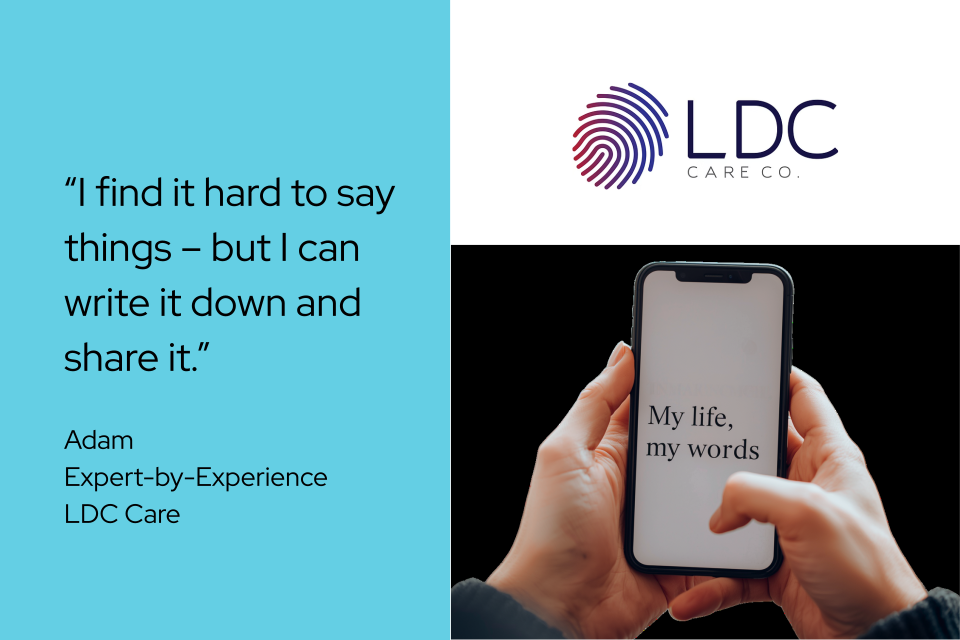
Adam began writing his own daily notes. He said:
“I find it hard to say things – but I can write it down and share it.”
This simple change gave him a new way to communicate and increased his confidence and sense of involvement.
Building on this, LDC Care introduced an AI-supported tool to assist with support plans. This work was developed collaboratively by Cheryll Champion, Head of Quality, Innovation and Compliance, and Keith Easley, Head of IT, ensuring that both care practice and technical design were aligned.
The AI reads daily notes, including those written by the person, and generates a draft support plan. Importantly, it does not create full care plans. Sensitive or complex areas remain the responsibility of staff and are explored through direct conversations.
The draft produced by AI is used as a starting point. It is reviewed and refined by the person, the care worker and the manager, ensuring that the final plan reflects real experiences and professional judgement.
The system itself is secure and closed, designed specifically for LDC Care. Data is not shared externally, supporting strong data protection and cyber security.
As Cheryll Champion explains:
“AI supports the role of care workers – it doesn’t replace them.”
Supporting staff to adopt AI
LDC Care recognised that introducing AI requires time and support. Managers were brought together in group sessions to learn from each other and build confidence. This helped address different levels of familiarity and encouraged open discussion.
The organisation also introduced the concept of AI before rolling out the tool, helping staff understand how it could support their work. Demonstrating time savings in drafting support plans helped build engagement.
At the same time, expectations remained clear. Staff are responsible for the content of support plans, and AI is there to assist, not replace decision-making. Regular spot checks by managers and regional leads ensure plans remain personalised and that staff maintain ownership.
Cheryll reflects:
“I was expecting much more push back on AI – but I’ve been positively thrilled at people’s response and the impact.”
Outcomes
The impact has been positive for both people drawing on care and staff.
People have more opportunity to express themselves in ways that work for them. Being able to write things down, rather than say them, can make a significant difference. For Adam, it has been something to feel proud of and has strengthened his involvement in his own care.
For staff, the AI-supported approach reduces the time needed to draft support plans while improving their quality. Because plans are based on real, day-to-day notes, including the person’s own contributions, they feel more accurate and meaningful.
As Cheryll explains:
“New support plans are really capturing the person because they are contributing directly in their own voice and their own time.”
More broadly, this approach shows how AI can enhance care when used responsibly. It supports better understanding and more personalised planning, while keeping human judgement at the centre.
Lessons learned
LDC Care highlights the importance of asking technology suppliers what is possible, as small changes can have a big impact. Being open with people drawing on care, and involving them in decisions about technology, helps build trust.
Starting with people who are interested and confident can help build momentum, while allowing others to develop skills over time. Creating a culture where learning is expected, and mistakes are part of the process, is equally important.
Looking ahead
LDC Care continues to develop its approach, with a strong focus on safe and ethical use of AI. Clear procedures, regular checks and shared learning across teams help maintain high standards.
Their experience shows that AI can be a positive force in adult social care when it is used thoughtfully, with appropriate human control and interaction.
As Cheryll puts it:
“You can use these AI tools and not lose the person.”
Find out more
Catch LDC and Adam talking about their use of tech at the Care Show London, 29-30 April.
#DigitalCareinFocus #AIinSocialCare
Tell your story
There’s nothing stronger than a story. Care providers – please share your experiences about using tech and data: what worked, what didn’t, and the lessons you’d like to pass on. Contact us to talk through the options.
View all case studies