September 16th 2026
A national commission has set out 44 recommendations for how AI should be regulated in healthcare, with a focus on safety, clear responsibility and public trust.
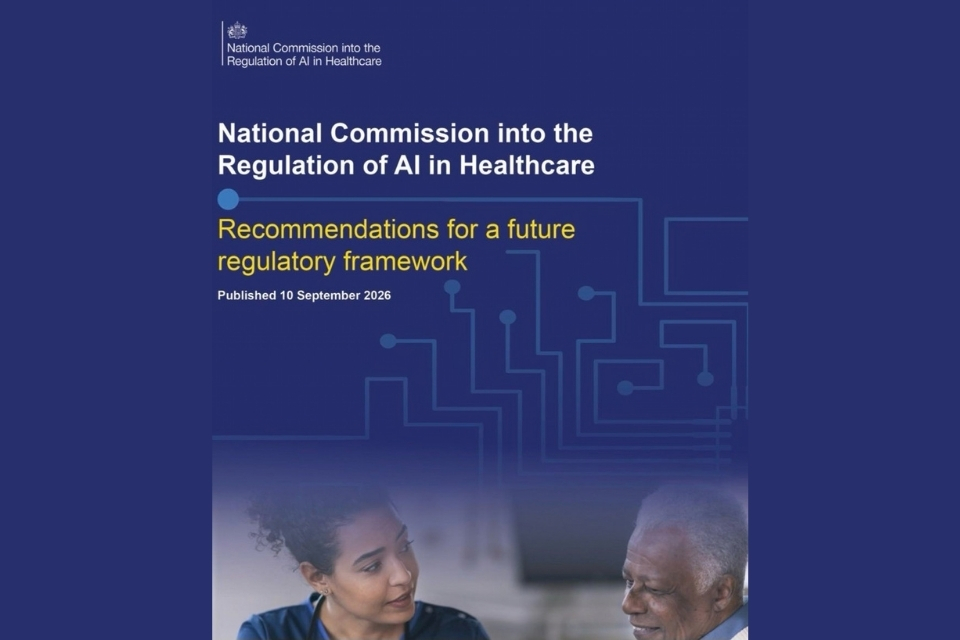
Published by the Medicines and Healthcare products Regulatory Agency (MHRA) on 10 September 2026, the report from the National Commission into the Regulation of AI in Healthcare makes recommendations to government on how AI can be used safely and effectively in healthcare. The Commission was set up by MHRA as an expert advisory group and included voices from clinical practice, regulation, law, technology, patients and the public.
Recommendations
The Commission says AI regulation needs to match the level of risk, follow products throughout their life, and take account of the people, data and organisations around the technology. This is important because AI tools can change quickly and may work differently in different settings.
- Testing promising AI tools in a controlled way: the Commission recommends an “L-plate style” approach, so some AI models can be used under close supervision while more evidence is gathered.
- Checking AI tools after they are introduced: AI-enabled medical devices should be monitored throughout their working life, not just approved once and left unchecked.
- Clearer public information: people should be able to find accessible information about the safety of specific AI-enabled medical devices, including reported problems.
- Stronger powers for the regulator: the report recommends giving MHRA stronger ways to act if manufacturers do not meet legal requirements or if patient safety is at risk.
- Clear responsibilities: manufacturers, healthcare providers, professionals, regulators and system partners should all understand their role in safe AI use.
- Practical support for organisations: the Commission recommends support such as an AI readiness toolbox to help health organisations introduce and manage AI safely.
Relevance to social care
The report is focused on healthcare, but it will also be relevant to adult social care as AI becomes more common across health and care. Care providers, local authorities, integrated care systems and technology suppliers will need to understand what good governance, accountability, transparency, data protection, staff confidence and safe implementation look like in practice.
Commenting on what this means for adult social care, Katie Thorn, Director of Innovation at Digital Care Hub, and co-convenor of the AI in Care Alliance said:
“AI is already starting to appear in tools used across health and care, so adult social care needs to be part of the conversation about safe and responsible use. Providers will need practical support to understand what an AI system does, what data it uses, who is accountable, how risks are reviewed, and how people drawing on care and support are informed and involved.”
Next steps
The government will respond separately, setting out how it plans to consider and take forward the recommendations. Digital Care Hub will continue to follow the response and any changes to regulation, assurance and guidance that may affect adult social care.
Read the full report on GOV.UK: National Commission into the Regulation of AI in Healthcare: Recommendations for a future regulatory framework.
View all News