November 18th 2026
Michelle Corrigan, our CEO, shares our own experience of the Microsoft outage and reflects on practising what we preach about business continuity planning.
Last week’s Microsoft outage gave me a very practical reminder of why business continuity matters. It feels rather different when it’s your own team trying to keep things going.
At Digital Care Hub, we spend a lot of time helping organisations plan for disruption, business continuity and cyber security. When Outlook stopped sending and receiving our emails, it was our turn to put that advice into practice.
What kept us working
We’re a small, virtual organisation, with colleagues scattered across England. Some work part-time. On the day, people were at events or on leave – including our cyber security lead. Normal working life, in other words, and exactly what a continuity plan needs to accommodate.
Fortunately, our secure Microsoft Teams environment remained available to us. We could talk to each other and to key partners, even though Outlook email was out of action. Our website, contact database and event booking system were also still working.
We were also lucky: no major webinar or announcement was scheduled that day. A small mercy, for which I cannot claim any strategic foresight.
Even great plans can be scuppered by a small detail. Take multi-factor authentication (MFA): it adds an extra identity check to your password, such as a code from an authenticator app on your mobile, making accounts harder to break into even if a password is stolen. A sensible protection – but what happens if the code you need arrives by email, and email is down?
That was the catch for us. A colleague could not access a Miro board because her sign-in code went to her email. Miro was working; she just could not get in. It wasn’t critical, but what if that had been our HR and payment systems, with payroll waiting to be processed?
And yes, don’t worry, my colleague has since changed her arrangements to use an authenticator app on a mobile, rather than relying solely on email for sign-in codes. The lesson was not to weaken security by saying we have to stop using MFA, but to make sure we could still use all our systems when email was unavailable.
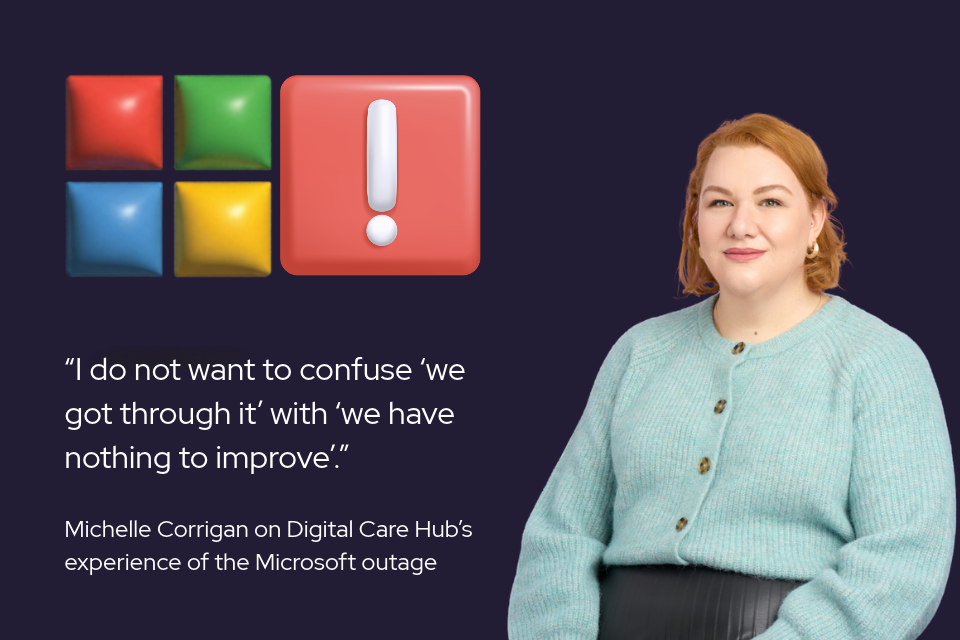
Our experience was generally reassuring, but I do not want to confuse “we got through it” with “we have nothing to improve”. A real incident is a useful opportunity to check and refresh arrangements, however well they served you.
For care services, the stakes are higher
Our disruption was manageable. For health and care services, the stakes were different. The Royal College of GPs reported problems with communications about referrals and prescriptions, some online consultation systems, and the resulting backlog.
NHS England described services activating contingency measures, including other IT systems and paper records, to help critical services and appointments continue.
For adult social care, the lesson extends beyond our own systems: can essential information still reach us from GPs, hospitals and pharmacies?
I was relieved the consequences were not even more significant. Where care continued, that reflected the work of staff and contingency arrangements – not a reason to take resilience for granted.
Back to the decidedly unglamorous basics
For us, this was a timely prompt to refresh contacts, alternative email addresses, responsibilities and access to the business continuity plan. I think of it as sensible housekeeping: give the plan a check each year, whenever critical systems change, and after an incident or exercise.
Not glamorous. But a current phone number is considerably more useful in an outage than an impressive strategy document nobody can open.
The essentials are straightforward:
- Keep contacts accessible. Maintain current team, partner and supplier details, securely available alongside the plan if systems go down.
- Plan communications. Have a communications checklist alongside your continuity plan: who updates staff, people drawing on care, families and partners, by which route and when? Agree deputies too.
- Prioritise essential work. Identify critical systems and safe alternatives. For care providers, start with safe care.
- Check the fallback. Would your backup option still work if your main technology supplier’s systems were unavailable? Agree secure alternatives before you need them.
- Check how you log in. Make sure essential systems remain accessible when email is down. Agree and test secure alternatives with your IT support or supplier. For example, if your email went down would you still be able to get MFA codes to log in to key systems? Can you get them via an App or just through email?
- Plan the recovery. Check missed messages, reconcile temporary records and follow up outstanding work once systems return.
Then try it. Before you have to.
And that same practical test applies to the whole continuity plan, not just logging in. The best way to build confidence is to practise it – including supplier failure.
Try this scenario: your care planning supplier’s system is unavailable for several days. How do staff securely access essential care information, use agreed alternatives and contact the supplier? Who updates families and partners? Now imagine the incident lead is on leave.
Involve the people who will use the plan, including part-time colleagues. Record who took part, the results and follow-up actions, then retest. Far better over a cup of tea than during an actual incident.
Our business continuity resources include a template, audit tool and testing guidance. Adapt these – and the communications checklist – to your service, and keep them accessible when your usual systems are not.
We kept working last week, and that was reassuring. It also brought home the value of taking time to check what we can make stronger. For me, that’s what practising what we preach means: keeping at it, not doing it once and ticking a box.
So, a question: if your usual systems stopped working tomorrow – and your go-to person was on leave – what would you do first?
View all News