October 8th 2026
Someone who can make their own breakfast would rather use their funded support to go out in the evening. It sounds straightforward. Yet making that choice work can mean changes to a support plan, staff rota, care record and funding information. The question is whether those systems help the person live the life they want, or make their choice harder to deliver.
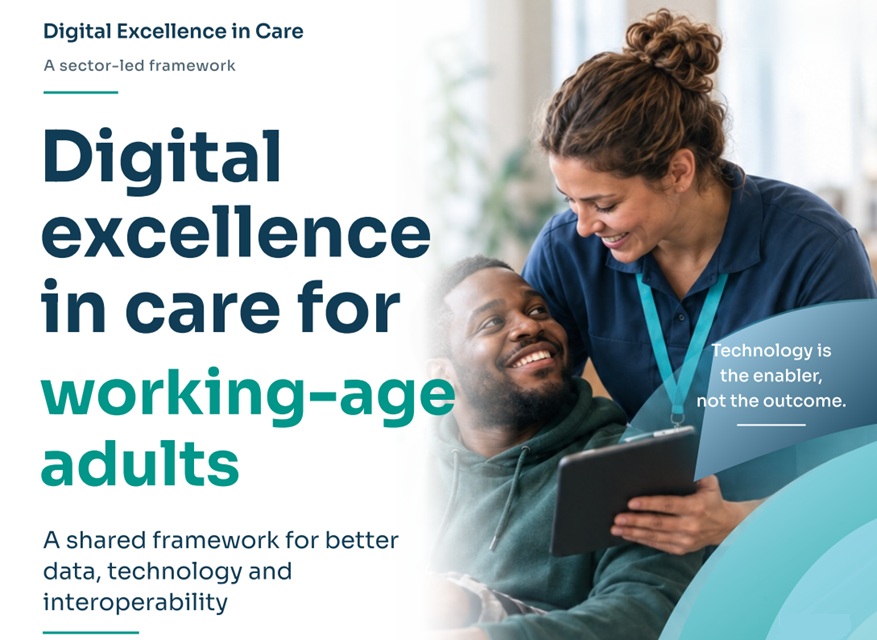
That illustrative example sits at the heart of Digital Excellence in Care (DEC) for working age adults, a new sector-led report published today, 8 October. Its starting point is not which technology to buy, but what should change for people when care organisations use information well.
Developed as a joint initiative of the Digital Excellence in Care group, Care England, Digital Care Hub and VODG, with Nourish Care and Sona as key contributors and sponsors, the report brings together provider experience and wider consultation. Learning Disability England gathered views from people supported and families, reinforcing the importance of accessible information, choice and human connection.
The report was formally launched at the Care Show in Birmingham with Peter Kinsey, Chair of Iris Care Group and the DEC Steering Group, joined by Lord Hunt.
Digital care records are an important foundation. But records alone cannot resolve information held in separate systems, repeated administration or inconsistent commissioner requirements. Data, technology and interoperability need to work together: information must be trustworthy, tools usable, and systems able to exchange information safely and meaningfully.
The report organises this challenge around TIDES: Transformation, Impact, Delivery, Engagement and Standardisation. Its eight connected domains cover people supported, families, finance, commissioning, the workforce, regulatory assurance, estates, and quality and improvement. These are not eight separate technology projects; their value lies in the connections between them.
For providers, there is a practical starting point. The four-stage Data Maturity Model helps organisations assess their position by domain. Requirement summaries and current- and future-state diagrams help teams identify where information is duplicated, missing or difficult to use, before deciding which changes matter most.
The digital supply partner charter and checklist give procurement conversations a clearer basis. Providers are encouraged to ask for evidence of data access, interoperability, usability, security and portability, alongside transparent implementation, support and exit costs. Investing in staff confidence and data governance matters alongside investing in software.
Providers cannot deliver this alone. The report asks government, NHS partners, commissioners, regulators and workforce bodies to address barriers beyond individual organisations. It also makes clear that anticipated improvements need testing in practice. A maturity model is not an accreditation standard, and technology does not remove human responsibility for decisions.
Michelle Corrigan, CEO of Digital Care Hub said:
“We were very pleased to be part of this project. Working-age adults are too often overlooked in discussions about digital care, so it is good to see a report that starts with their lives, choices and ambitions. It also makes a simple but important point: digital technology should be part of good care, not an add-on or an extra cost. That means providers and commissioners working together so technology and information can support better outcomes and new ways of delivering care — not just replace paper with a screen.”
Fiona Florey, Digital Care Hub’s Engagement Manager and member of the Steering Group that developed the report said:
“We were delighted to be involved in developing this report, bringing together different organisations, expertise and perspectives to create something that keeps people at the heart of its recommendations and outputs. It provides the sector with a strong opportunity to approach the Neighbourhood Health agenda, particularly its digital and data foundations, as a considered, credible and collaborative collective – rather than as individual services working in isolation.”
The report, Easy Read and two-sided leaflet are available through Care England’s permanent DEC resource page. Further work is proposed on a data-use library, practical roadmap and implementation support. For now, providers have a shared basis for choosing their priorities and discussing them with staff, people supported and partners.
Read the report and supporting resources on the Care England website.
View all News