Help shape digital support for adult social care
Share your experience to help improve digital support for adult social care. To get involved, please complete our Expression of Interest form and tell us which topics and activities interest you.
The Digital Expertise and Engagement (DEE) project brings together care providers’ experiences to help shape practical guidance, support and technology choices for adult social care in England.
It is a joint project between Care England and Digital Care Hub, funded by the Department of Health and Social Care (DHSC). The project’s guidance and resources will be published on GOV.UK in spring 2027.
Summary
The project covers:
- Fully digitised and joining up data: Practical support with digital social care records, DSPT standards and sharing information across health and social care.
- Connectivity and digital switchover: Help with internet and phone connections, the move to digital phone services and keeping services running during disruption.
- Digital skills and workforce: Understanding staff’s digital skills needs and improving frameworks, support materials and access to learning.
- AI guidance and communications: Practical learning, case studies and guidance to help providers understand AI’s benefits and risks and make informed choices.
- Standards and evidence: Learning from care technology pilots and developing evidence standards to help providers assess and use digital tools.
You can get involved in multiple ways on each topic such as:
- Completing a survey.
- Joining a workshop to share your experiences and support needs.
- Contributing a case study
- Attending webinars to explore practical guidance and learning.
See details below on each topic.
Background
The project supports the commitments DHSC made in January 2025 to:
- Set national standards and provide trusted guidance so people who draw on care, their families and care providers can choose safe, effective care technology.
- Join up health and care systems, including through a shared platform, so staff can access up-to-date social care, GP and hospital information.
- Make sure all care providers are fully digitised by the end of the parliament, with staff able to access essential medical information.
Under DHSC’s guidance, a fully digitised provider:
- is registered with the Care Quality Commission (CQC) and
- uses an assured digital social care record (DSCR) solution and
- achieves at least “standards met” on the Data Security and Protection Toolkit (DSPT).
Who the project is for
The guidance and support are mainly for CQC-registered adult social care providers in England, across all types of service. The project will focus particularly on micro and small providers, providers who face barriers to using digital technology or whose views are rarely heard, and organisations serving marginalised communities.
Commissioners, care associations, consultants and technology companies can also take part where they help providers use digital technology.
Providers’ views and experiences will be shared with DHSC throughout the project to help shape policy. Learning will also be shared with other organisations identified by DHSC, such as NHS England and the Health Innovation Networks.
Five topics
The project has five areas of work. Please use our Expression of Interest form to register your interest in the activities below. Select the topics that interest you and how you would like to get involved.
1. Fully digitised and joining up data
This work will look at what makes it difficult for providers to start using digital social care records (DSCRs), get more from them, choose assured systems and meet DSPT standards. It will produce practical guidance on setting up and using DSCRs, becoming fully digitised and using GP Connect through an assured DSCR. Providers’ experiences will also help shape national systems for sharing information across health and social care.
How to get involved
We particularly want to hear from smaller organisations and services that are not yet fully digitised, including care providers who do not yet use a DSCR or who have one but make limited use of it. You do not need to be a digital expert. We want to hear honestly about what works, what gets in the way and what practical support would make the biggest difference.
Complete the DSCR survey
Complete the DSCR survey by Friday 20 November 2026.
Join a workshop: Friday 20 November 2026, 12–1.30pm on MS Teams. Share your experiences, barriers and support needs as a service using or considering digital social care records (DSCRs). We’ll explore choosing and implementing a DSCR; costs, time and capacity; staff confidence, training and change; and the guidance, resources or support that would be most useful.
To request a place, email [email protected] or complete our Expression of Interest form. We will contact you to confirm availability and send a meeting invitation.
Take part in a one-to-one interview
We have a limited number of slots available.
Share a case study
Share a case study about choosing, setting up or using a DSCR, including any challenges and what you learned.
Attend a webinar
There will be one webinar on becoming fully digitised and two on GP Connect, with practical guidance to support them. Dates will be confirmed.
2. Connectivity and digital switchover
This work will gather experiences of internet and phone connections and the move to digital phone services, including telecare. It will look at how services rely on existing phone networks and mobile coverage. Guidance and case studies will help providers plan for disruption, respond when connections fail and keep services running.
How to get involved
Join a workshop
For care providers: 2 December 2026, 1–2.30pm on Teams. We’ll discuss connectivity and the digital switchover in adult social care, exploring practical challenges, risks and support needs. Your experiences will help shape recommendations, guidance and case studies for DHSC.
We’d like you to share how your service relies on telephone lines, broadband, mobile connections or connected equipment; any connectivity difficulties or experiences of preparing for the digital switchover; what these challenges mean for staff and people drawing on care; and the practical guidance, resources or support that would help most.
You do not need to be a digital or technical expert, and no formal preparation is required. Come ready to share your experiences, bring a practical example if you can, and help prioritise the issues and support needs that matter most.
We are also arranging a workshop for telecare providers and local authorities (date to be confirmed). Both workshops will look at the connections services rely on and the challenges they face.
Share a case study
Share a practical example of a connectivity or digital switchover challenge and the steps your service has taken in response. Examples could include:
- Reliance on analogue telephone lines, broadband, mobile connections or connected care equipment.
- Identifying services, people or devices affected by the digital switchover.
- Preparing for connectivity or power interruptions through backup arrangements or contingency processes.
- Coordinating changes with local authorities, telecare suppliers, housing providers or communications providers.
- Helping staff, people drawing on care and families understand and prepare for the switchover.
To share a case study, contact [email protected] or [email protected].
Attend a webinar
Attend a webinar on the digital phone switchover and use the guidance to help keep services running if connections fail. Dates will be confirmed.
3. Digital skills and workforce
This work will bring together care providers and workforce groups to understand the digital skills staff need as their roles and responsibilities change. Their feedback will help update digital skills frameworks and support materials. The project will also help providers and staff find and access opportunities to develop their digital skills.
How to get involved
Join a workshop
Share your service’s digital skills needs, experiences and priorities to help improve frameworks and support materials. Dates to be confirmed.
Attend a webinar
Find out about opportunities for care staff to develop their digital skills. Dates will be confirmed.
4. AI guidance and communications
This work will help adult social care providers understand the benefits and risks of artificial intelligence (AI) and make informed choices about it. Blogs, examples of how AI is used, and guidance will share practical learning. There will also be four AI case studies, guidance on technology to help prevent falls, and a webinar.
How to get involved
Contribute to an AI case study: Share your experience of using AI in care to help develop the four planned case studies.
Attend a webinar and explore blogs, examples and guidance to help you make decisions about AI. Dates will be confirmed.
5. Standards and evidence
This work will share lessons from the Adult Social Care Technology Fund (ASCTF) care technology pilots. It will also help develop expectations or standards for the evidence needed to show how well digital technologies work in adult social care. A webinar and guidance will help providers assess digital tools and put them into use with greater confidence.
How to get involved
- Attend a webinar: hear what the care technology pilots found and what the findings could mean for your service. Dates will be confirmed.
- Use the guidance to help you assess digital tools and decide how to use them. Guidance to follow.
Have your say
To get involved, please complete our Expression of Interest form.
This is the main way to tell us which topics and activities interest you. Submitting the form does not confirm a booking; we will contact you about relevant opportunities.
Project timetable
The project runs until 31 March 2027:
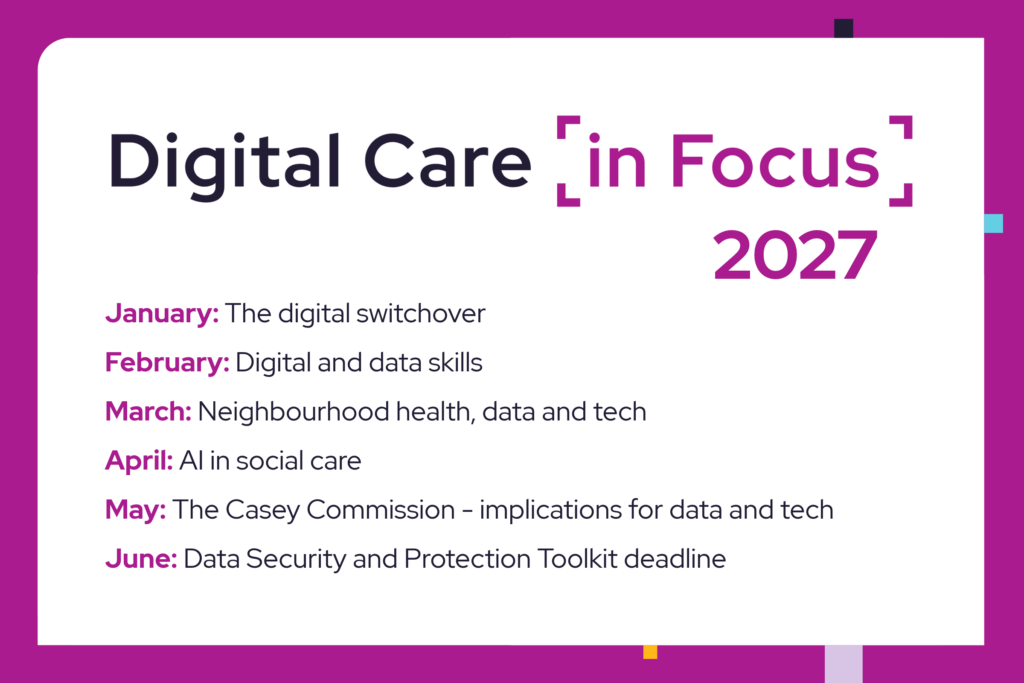
- November–December 2026: gather care providers’ views and experiences.
- January–March 2027: use providers’ feedback to finalise guidance and resources, run webinars and share learning.
How we will use your data
We will use the information you provide only for this project, including to contact you about your interests and manage your involvement. Your information will be shared between Care England and Digital Care Hub. Anonymised information will be shared with DHSC to help shape guidance and policy. DHSC will not take part in workshops.
See Digital Care Hub’s Privacy Policy for details.
Further information
Explore DHSC’s guidance and resources on digitising adult social care.
Sign up for Digital Care Hub’s newsletter to stay up to date with the project including opportunities to get involved. You can unsubscribe any time.
For general enquiries about the project, email [email protected].